How to Block Knitting and Crochet (Wet, Steam & Spray Blocking by Fiber)
Quick answer: To block knitting or crochet, get the finished piece wet (by soaking, spraying or steaming), shape it to the pattern's measurements on a flat, pinnable surface, and let it dry completely. Your fiber decides the method. Wool and other animal fibers respond well to a soak. Cotton and linen need support so they don't stretch. Acrylic barely responds to water and is permanently changed by heat (KnitPicks, Interweave).
By: YarnCompass Editorial Team
Photos by: Carole Rubin
Published: 2026-11-20
Updated: 2026-11-20
Fact-checked: 2026-11-19
TL;DR
- Blocking is the finishing step that evens out stitches, opens up lace, flattens curling edges, and sets a piece to its finished size (KnitPicks, Lion Brand).
- There are three main methods. Wet blocking means soaking the piece. Spray blocking means pinning it dry and then misting it. Steam blocking means holding steam above the fabric, never pressing an iron onto it (KnitPicks, Vogue Knitting).
- Acrylic is the exception. Water does very little to it, and heat changes it permanently. Lion Brand advises against steam-blocking acrylic (Lion Brand, Interweave).
- Always block your gauge swatch the same way you'll block the finished piece. Blocking can change gauge, especially in lace, cables and linen (Vogue Knitting).
Who this guide is for
This guide is for knitters and crocheters who have finished a piece, or are about to swatch for one, and want to know whether to block it, how to block it, and what their yarn's fiber will put up with. It's especially useful if you're choosing between wool, superwash, cotton, linen, alpaca or acrylic for a project, because the fiber you buy decides how much blocking can do for the finished piece.
Table of contents
- What blocking is and why it matters
- The three blocking methods: wet, spray and steam
- Which blocking method for which fiber
- How to wet block, step by step
- How to block lace, garments, blankets and swatches
- How to block crochet
- Blocking tools: mats, pins, wires and wool wash
- Decision framework
- Common mistakes
- FAQ
- Sources and fact-check log
What blocking is and why it matters
Blocking is the process of wetting or steaming a finished piece, then shaping it to the right size and letting it dry in that shape (Lion Brand). KnitPicks describes blocking a sweater as "setting the stitches and evening out the fabric in addition to preserving the correct sizing" (KnitPicks).
In practice, blocking can do four things:
- Even out stitches. Uneven tension, in colorwork for example, often looks smoother after a soak.
- Open up lace and texture. Lace looks crumpled off the needles and only shows its pattern once it's stretched and dried. Interweave's lace shawl tutorial shows a shawl growing about 8 inches across the top just from being wet, before any pinning (Interweave).
- Set the size and shape. You can coax pieces to the measurements on the pattern schematic. That makes seaming easier, and a garment is more likely to fit.
- Flatten curling edges. Stockinette edges and crochet corners tend to curl or cup until they're blocked.
Blocking can't fix every problem. It won't make a sweater a full size bigger, and it does very little to most acrylic (see the fiber section). If your gauge is off, the fix is a different needle or hook size, not hard blocking. Our gauge and swatching guide explains how to adjust.
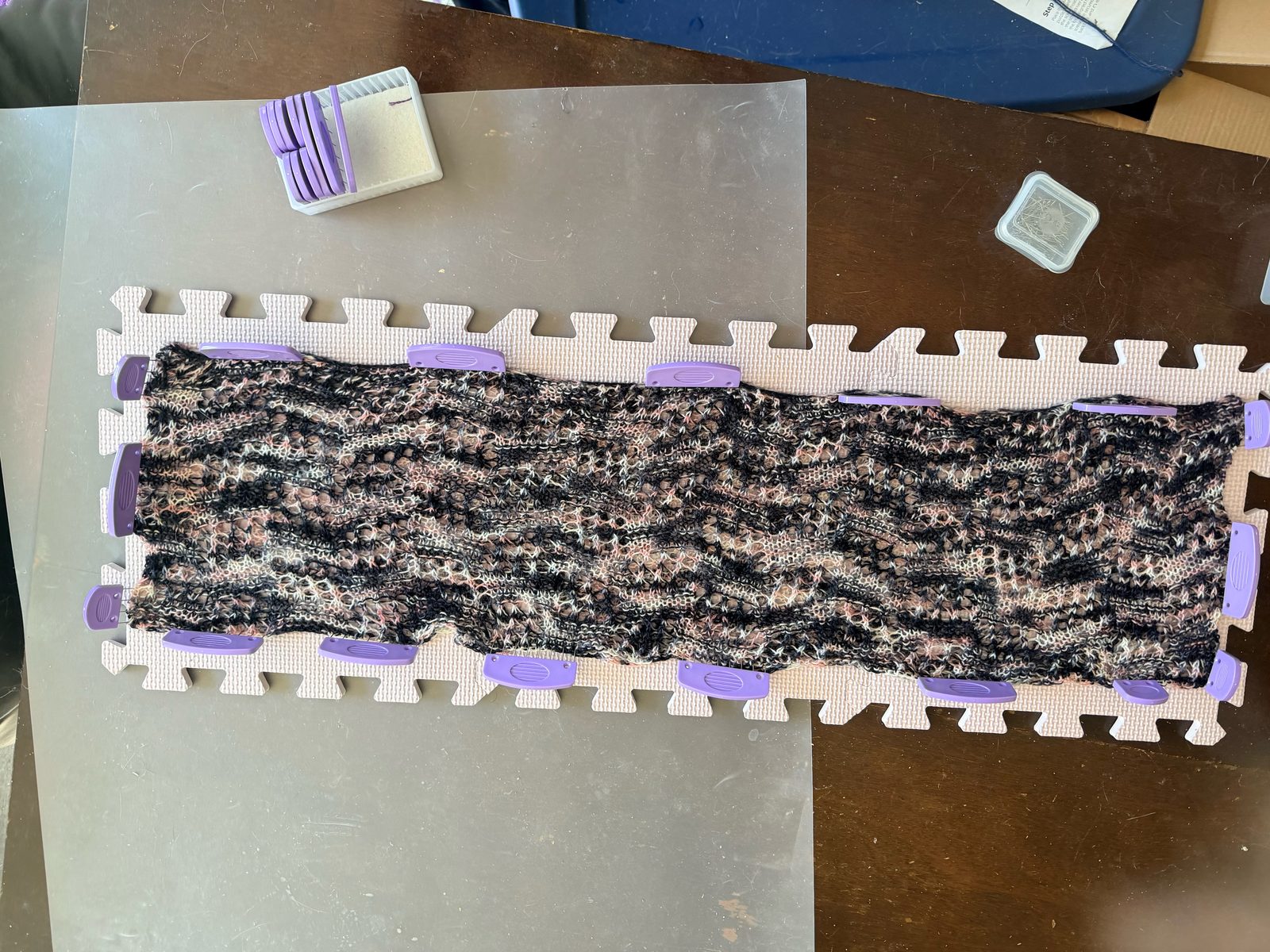
The three blocking methods: wet, spray and steam
Wet blocking (soaking)
You fully soak the finished piece, press out the excess water, then shape and dry it flat. KnitPicks recommends wet blocking for wool and animal fibers in general. It suggests lukewarm water, a soak of at least 10 minutes and up to 30, and warns that hot water can felt wool (KnitPicks). Wet blocking gives the most even result, but it takes the longest to dry.
Spray blocking (misting)
You pin the dry piece to its finished shape first, then mist it with water until it's damp and leave it to dry (KnitPicks). It's gentler and faster than soaking, so it works well for small crochet pieces, motifs, and fibers that get heavy or weak when wet. Vogue Knitting's fiber chart lists spray blocking for rayon unless the ball band says otherwise (Vogue Knitting).
Steam blocking
You hold a steam iron or garment steamer just above the fabric and let the steam relax the stitches, then pat the piece into shape. Vogue Knitting's rule: "Never place a hot iron directly on knitted fabric." Hold the iron about half an inch above the fabric and use the steam setting (Vogue Knitting). Steam is quick and good for wool, but it's the method most likely to damage heat-sensitive fibers, so test it on your swatch first.
| Method | How wet the piece gets | Best for | Watch out for |
|---|---|---|---|
| Wet blocking | Fully soaked | Wool, most animal fibers, cotton, linen, lace | Long drying time. Support the weight so it doesn't stretch. |
| Spray blocking | Damp | Small pieces, crochet motifs, delicate or blended yarns | Less dramatic for lace than a full soak |
| Steam blocking | Lightly damp | Wool, flattening edges, quick touch-ups | Heat. Can melt or flatten acrylic and scorch cotton. |
Which blocking method for which fiber
Your yarn's fiber content matters more than anything else here. Always start with the care instructions on the ball band. KnitPicks and Vogue Knitting both say to consult the yarn label and test on a swatch before blocking the finished piece (KnitPicks, Vogue Knitting). If you're still choosing a fiber, our types of yarn guide compares them.
| Fiber | Recommended method | Key caution |
|---|---|---|
| Wool (not superwash) | Wet block, or steam held above the fabric | Hot water and agitation can felt it |
| Superwash wool | Wet block gently; dry flat | Can grow when wet; don't stretch past the target size |
| Alpaca | Spray or steam; a gentle soak works if fully supported | Heavy and drapey when wet; can lengthen |
| Cotton | Wet block or gentle steam | Inelastic, so it stretches under its own weight; scorches if steam is too hot |
| Linen | Wet block; it also takes warm or hot steam | Can change size a lot, so block the swatch before measuring gauge |
| Acrylic | Usually light wet or spray blocking; heat only on purpose | Heat changes it permanently ("killing" acrylic) |
| Blends | Block for the most delicate fiber in the blend | Test on a swatch |
Wool
Untreated wool responds the most to blocking. It relaxes when wet and dries into the shape you pin. Vogue Knitting's chart lists wet blocking, or dry blocking with warm steam (Vogue Knitting). Use lukewarm water and never run it under the tap or agitate it, since heat plus agitation can felt it (KnitPicks). Compare wool yarn prices across 106 shops.
Superwash wool
Superwash wool has been treated so it resists felting, but that also changes how it behaves when wet. It tends to relax and grow more than untreated wool. TECHknitting notes that a superwash item dried flat can end up much bigger than the same item machine-dried (TECHknitting). Block it to your target measurements, not past them, and dry it flat. Our superwash wool guide covers care in more detail.
Alpaca
Alpaca is warm and drapey, but it has less spring than wool. KnitPicks groups wool and alpaca together as good candidates for spray or steam blocking (KnitPicks). Knitting sources also warn that alpaca can lengthen under its own weight when wet (Millicent's Yarns). If you soak it, lift it out with both hands and never hang it to dry. Compare alpaca yarn prices.
Cotton
Interweave calls cotton "extremely non-elastic". Its advice is to support the fabric so it isn't pulled by its own weight while wet, and to keep any heat low to medium, because cotton can shrink with too much heat (Interweave). Vogue Knitting adds that cotton scorches if the steam is too hot (Vogue Knitting). Compare cotton yarn prices.
Linen
Linen is strong and actually gets stronger when wet (Interweave). It tolerates wet blocking and warm or hot steam (Vogue Knitting). Berroco's creative director told Vogue Knitting that some linen yarns change substantially in length and width after blocking, so "the only way to determine the gauge is from the blocked swatch" (Vogue Knitting). Compare linen yarn prices.
Acrylic, and the steam warning
Acrylic is a synthetic fiber that reacts to heat rather than water. Soaking it does very little. KnitPicks says blocking "is often unnecessary with synthetic yarns" (KnitPicks). Lion Brand, one of the largest acrylic yarn brands, says that because acrylics are sensitive to heat, "they should not be steam blocked" (Lion Brand).
What "killing acrylic" means: Some makers steam acrylic on purpose, holding the iron above the fabric without touching it, to flatten the fabric and give it more drape (A Bee in the Bonnet). The change is permanent. The fabric loses its loft and springiness and won't bounce back. Interweave warns that direct heat can melt or scorch acrylic, so an iron should never touch it (Interweave). If you want to try it, test on a swatch first and pin the piece to its final shape before applying heat.
For most acrylic projects, such as blankets, amigurumi and everyday accessories, a light wash or spray and laying the piece flat to dry is enough. If you want a fabric that blocks dramatically, especially for lace, choose an animal fiber instead. Our merino vs acrylic guide compares the two, including cost.
Blends
For blends, block according to the most delicate fiber in the mix. Lion Brand's editorial director told Vogue Knitting that she doesn't steam garments made from blends of manufactured and animal fibers (Vogue Knitting). When you aren't sure, try the method on your swatch first.
How to wet block, step by step
This is the standard soak method, based on the KnitPicks process (KnitPicks).
- Check the ball band. Look for water temperature and care symbols. Take the pattern's finished measurements or schematic so you have them handy.
- Fill a clean basin with lukewarm water. Add a little wool wash if you like. No-rinse wool washes are made for this step.
- Submerge the piece. Press it gently under so it's fully soaked. Don't run it under the tap or agitate it.
- Soak for 10 to 30 minutes.
- Lift it out with both hands. Support all of its weight so wet fabric doesn't stretch. Squeeze gently, and never wring it.
- Roll it in a towel. Lay it flat on a clean towel, roll it up, and press to remove more water.
- Shape it on a pinnable surface. Use blocking mats, foam tiles, or towels layered on a bed or carpet. Pat the piece to the schematic measurements, using a tape measure or the grid on your mats.
- Pin where needed. Use rust-proof T-pins along edges, or blocking wires for straight edges and lace points.
- Let it dry completely. Don't move it until it's fully dry. Depending on the fiber, the thickness of the piece and your room, that can take a day or more.
## How to block lace, garments, blankets and swatches
Lace shawls
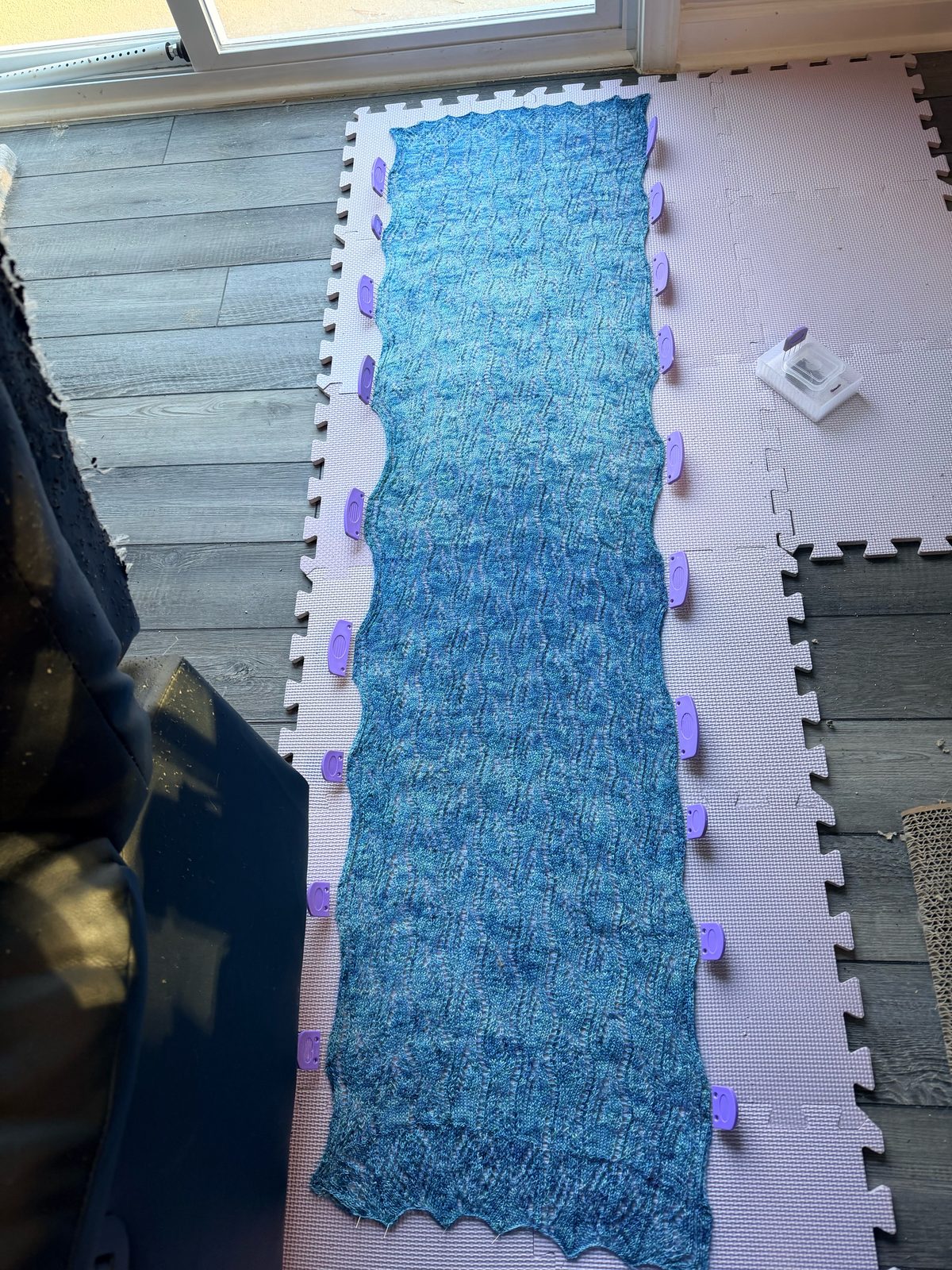
Lace benefits most from a full soak followed by firm shaping. The Interweave method runs blocking wires through each point along an edge, leaving the corner points off the wires. You line the wires up with straight guides on the blocking board, pin against the wires rather than through the lace, then pin the corner points separately with T-pins (Interweave). Work from the center outward so the motifs line up. Wires make straight edges with far fewer pins than pinning every point by hand.
Sweaters and other garments
Block garment pieces to the pattern schematic. Most knitters block pieces before seaming, which makes the edges easier to match. You can also block the finished sweater. Never hang a wet garment, because the weight of the water will pull it longer. Dry it flat. KnitPicks lists wet blocking as good for cotton and linen, and spray or steam blocking as good for wool and alpaca (KnitPicks).
Blankets
Large blankets are hard to soak and lay flat at full size. Spray blocking on the floor or a bed covered with towels or mats works well. You can also wash the blanket the way its yarn's care label allows and lay it flat to dry. If you're still choosing yarn, our best yarn for blankets guide covers easy-care fibers.
Swatches and gauge
Block your gauge swatch exactly the way you'll block the finished piece, then measure it once it's dry. Vogue Knitting notes that a blocked swatch shows your true stitch and row gauge, and that lace and cables "change dramatically after blocking" (Vogue Knitting). Measuring an unblocked swatch is one of the most common reasons a finished garment doesn't fit. See our gauge and swatching basics for how to measure.
How to block crochet
Crochet follows the same principles. Wet the piece, shape it, and let it dry, choosing the method by fiber. Some notes for crochet:
- Granny squares and motifs: Block them all to the same size before joining so the seams line up. A blocking board with a grid, or pins set at a fixed spacing, keeps them identical. Spray blocking is fast for a stack of squares.
- Crochet lace and doilies: These open up the same way knitted lace does. Soak, then pin out each point or picot.
- Amigurumi and stuffed toys: These usually don't need blocking, because the stuffing gives them their shape. (This is Yarn Compass editorial guidance, not a quoted source.)
- Acrylic crochet: The same heat warning applies. A light spray and drying flat is usually enough.
If you're picking yarn for toys, see our best yarn for amigurumi guide.
## Blocking tools: mats, pins, wires and wool wash
You don't need much, and you can start with towels.
- Blocking mats: Interlocking foam mats, often printed with a grid, give you a pinnable surface. A stack of towels on a bed or carpet works as a free substitute (KnitPicks).
- T-pins: Rust-proof pins hold edges and points in place while the piece dries (KnitPicks).
- Blocking wires: Long, flexible wires threaded along edges give lace and straight edges clean lines with fewer pins (Interweave).
- Wool wash: A gentle, pH-neutral wash made for fine fibers. Some are no-rinse (Vogue Knitting).
- Spray bottle and steam iron or steamer: For spray and steam blocking.
- Tape measure and your pattern schematic: So you block to measurements rather than by eye.
Decision framework
Ask these three questions in order:
- What is the fiber? Wool, superwash, alpaca and other animal fibers: soak or steam. Cotton or linen: soak with full support, and use gentle steam only if the label allows it. Acrylic: light spray or wash, no direct heat, and deliberate steam only after testing on a swatch. Blends: treat them like the most delicate fiber in the mix.
- What does the piece need? Lace or texture that needs opening: soak plus firm pinning or wires. Curling edges or a size tweak: spray or steam. A blanket or a piece that's already even: a light spray, or a wash and lay flat.
- Have you tested it? If you haven't tried the method on a swatch of this yarn, do that first.
The fiber you choose at the shop is the biggest blocking decision you'll make. If you want lace that blocks crisply, pick a wool or wool-blend yarn. If you want easy care and no blocking, pick acrylic or superwash and accept that it won't change much. Compare yarn prices across 106 shops, or use the yarn weight chart to match the weight your pattern calls for. If you're swapping fibers, see how to substitute yarn.
Common mistakes
- Pressing an iron onto the fabric. Hold steam above the fabric instead. Direct heat can flatten, melt or scorch it (Vogue Knitting, Interweave).
- Steaming acrylic without testing. The change is permanent. Lion Brand advises against steam-blocking acrylic (Lion Brand).
- Hot water or agitation with non-superwash wool. This risks felting. Use lukewarm water and gentle handling (KnitPicks).
- Wringing, or lifting a wet piece by one corner. Support the full weight and squeeze gently (KnitPicks).
- Hanging a wet sweater to dry. Cotton, alpaca and superwash in particular can lengthen. Always dry flat.
- Over-stretching superwash. It grows more than you expect, so block to the target size, not past it (TECHknitting).
- Measuring gauge on an unblocked swatch. Block the swatch first (Vogue Knitting).
- Unpinning before the piece is fully dry. It can spring back out of shape.
- Using pins that rust. Use rust-proof T-pins, especially on light-colored yarn.
FAQ
What is blocking in knitting?
Blocking is the finishing step where you wet or steam a finished knitted or crocheted piece, shape it to its intended measurements, and let it dry so the stitches even out and the shape sets (Lion Brand, KnitPicks).
Do I need to block every project?
No. Lace, garments that need to fit, colorwork, and pieces that will be seamed benefit most. Many acrylic and novelty yarns need little or no blocking, and yarn-company experts interviewed by Vogue Knitting skip blocking when the stitches are already even and the measurements are exact (Vogue Knitting, KnitPicks).
What is the difference between wet blocking and steam blocking?
Wet blocking soaks the whole piece in water before you shape it and dry it flat. Steam blocking uses steam from an iron or steamer held above the fabric, so the piece only gets lightly damp. Wet blocking is more thorough. Steam is faster but riskier for heat-sensitive fibers (KnitPicks, Vogue Knitting).
Can you block acrylic yarn?
Yes, but water alone does little to it. A light wash or spray and drying flat can tidy it up. Heat changes acrylic permanently, and Lion Brand says acrylics should not be steam blocked. Some makers steam acrylic on purpose ("killing" it) for more drape, but they test on a swatch first, because the change can't be undone (Lion Brand, Interweave).
How do I block crochet?
The same way as knitting. Choose a method by fiber, wet the piece (or pin it first and spray it), shape it to size on a pinnable surface, and let it dry completely. Block granny squares to the same size before joining them.
Can I block without blocking mats?
Yes. Layered towels on a bed, carpet or spare mattress make a pinnable, absorbent surface (KnitPicks). Mats with a printed grid just make it easier to get straight, even measurements.
How long does blocking take to dry?
It depends on the fiber, the thickness of the piece, humidity and airflow. Thin lace can dry in hours, while a heavy wool sweater can take a day or more. Leave it pinned until it's completely dry.
Should I block before or after seaming?
Many knitters block pieces before seaming so the edges match the schematic and are easier to sew. You can lightly re-block, or steam the seams if the fiber allows, after assembly. Lion Brand's editorial director told Vogue Knitting she steam-blocks seams from the inside of the garment (Vogue Knitting).
Sources and fact-check log
| Claim or section | Source | URL | Last checked |
|---|---|---|---|
| Wet, spray and steam methods; soak time; water temperature; towel roll; T-pins; synthetics often don't need blocking | KnitPicks, Blocking Sweaters | https\://www.knitpicks.com/learning-center/blocking-sweaters | 2026-11-19 |
| Acrylic is damaged by direct heat; cotton is inelastic and heat-sensitive; linen is stronger wet | Interweave, Blocking Tips: Acrylic and Other Non-Woolly Fibers | https\://www.interweave.com/article/knitting/blocking-tips-acrylic-and-other-non-woolly-fibers/ | 2026-11-19 |
| Blocked swatch shows true gauge; lace and cables change; linen gauge; fiber chart; never put an iron on the fabric; blends | Vogue Knitting, Wear and Care | https\://www.vogueknitting.com/articles/wear-and-care/ | 2026-11-19 |
| Definition of blocking; acrylics should not be steam blocked | Lion Brand Notebook | https\://www.lionbrand.com/community/blog/q-a-what-is-blocking-and-what-can-it-do-for-me | 2026-11-19 |
| Blocking wires on a lace shawl; shawl grows when wet | Interweave, Using Blocking Wires to Block a Lace Shawl | https\://www.interweave.com/article/knitting/using-blocking-wires-to-block-a-lace-shawl | 2026-11-19 |
| Superwash grows when dried flat | TECHknitting | https\://techknitting.blogspot.com/2011/05/ | 2026-11-19 |
| "Killing" acrylic with steam held above the fabric | A Bee in the Bonnet | https\://www.abeeinthebonnet.com/blog/the-ultimate-simple-guide-to-blocking-your-knitting/ | 2026-11-19 |
| Alpaca lengthens when wet; never hang wet garments | Millicent's Yarns | https\://millicentsyarns.com/blocking-a-hand-knit-sweater | 2026-11-19 |
Yarns to price-check on YarnCompass
Madelinetosh Tosh Merino Light Yarn - Custom: JBW: Virginia Is For Makers
From $32.00 at Jimmy Beans WoolMadelinetosh
Madelinetosh Tosh Merino Light Yarn - Swipe Right
From $32.00 at Jimmy Beans WoolIce Yarns
Miona
From $3.99 at Ice YarnsIrish Artisan Yarn
Lace Suri Alpaca/Silk - Undyed Yarn
From $12.00 at Irish Artisan YarnSchoppel Wolle
Edition 6
From $14.00 at Eat.Sleep.Knitmeadowyarn
miniBray | lace
From $10.00 at Meadow Yarn
Compare yarn prices on YarnCompass → · Yarn weight chart · Deal search